




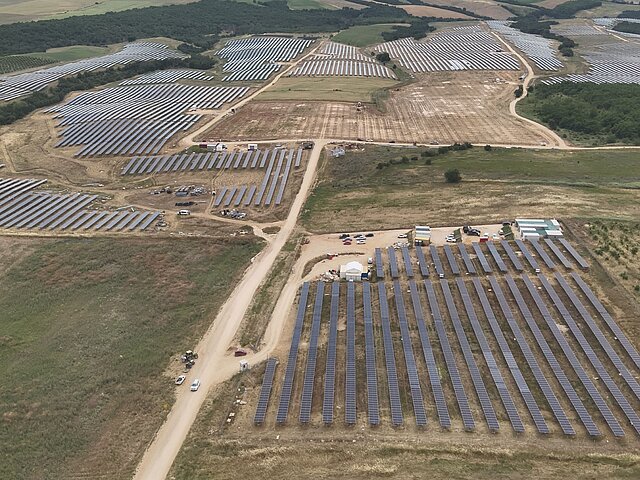
JUWI is currently developing wind and solar projects worldwide with a total capacity of one gigawatt
Over the past 30 years, JUWI has planned and constructed over 3,500 megawatts of wind power capacity and over 4,000 megawatts of PV capacity worldwide—with approximately 1,000 megawatts of renewable energy set to be added in the coming months. With the start of module installation at the Triffyli solar park in Greece, JUWI has reached the milestone of one gigawatt of capacity being installed simultaneously across its many construction sites worldwide. “This once again demonstrates our planning and implementation expertise. Our implementation activities are currently in full swing,” emphasizes JUWI CEO Jost Backhaus. In total, JUWI is currently installing around 1.3 million solar modules across twelve projects, as well as 46 wind turbines.
The “Trifylli” solar park in northern Greece, about 400 kilometers north of Athens, is part of the “Clover” PV portfolio that JUWI is currently constructing for the investor Mirova. It consists of a total of four projects with a combined capacity of 156 megawatts, all of which are scheduled to come online by next year at the latest. In total, JUWI is currently building PV projects at seven locations in Greece with a combined capacity of over 400 megawatts. In Greece in particular, construction workers repeatedly come across historical artifacts. “This requires a high level of problem-solving expertise from our planning and implementation teams to minimize delays and constant adjustments to the plant configuration,” Backhaus added.
JUWI employees are also working on the construction of clean energy plants on the African continent. The “Grande Cote Operation” PV hybrid park in Senegal, which is being built for the mining and metals company Eramet, is nearly complete. About 100 kilometers northeast of the capital, Dakar, the constructing of a 20.3-megawatt PV plant along with a battery storage system (capacity: 11.12 MW) is almost finished. In contrast, PV construction sites in South Africa are still in full swing: a total of three projects with a combined capacity of around 350 megawatts are currently underway.
While the international focus is on the PV business, wind energy is the primary driver of revenue for the JUWI Group in Germany. JUWI is currently constructing a total of 46 wind turbines with a combined capacity of approximately 270 megawatts at eleven sites (Brandenburg, Rhineland-Palatinate, Lower Saxony, Saxony-Anhalt, and North Rhine-Westphalia).
In addition, planning for the next construction projects is in full swing in the U.S. and Italy. By the end of 2025, JUWI had commissioned two major PV projects in each of these countries: One of the two U.S. solar parks is Axial Basin Solar, a 186-megawatt project in Moffat County in northwestern Colorado, about 250 miles northwest of Denver. The second PV plant in the U.S. is Dolores Canyon Solar. This solar park has a capacity of 141 megawatts and is located in Dolores County, about 400 kilometers southwest of Denver.
JUWI Energie Rinnovabili S.r.l. also commissioned two large-scale photovoltaic projects last fall. In Sardinia, JUWI employees connected a 41.7-megawatt solar park to the power grid. Here, too, the challenges during the construction phase were significant: to the surprise of everyone involved, archaeologists discovered numerous remains of historical structures while monitoring the construction. These are believed to be parts of a settlement dating back some 6,000 years, including churches and graves. The second Italian project is located about 70 kilometers south of Venice in Rovigo. At the Loreo solar park, civil engineers faced fewer archaeological challenges but had to contend with the soft soil in the coastal marshland.